


America has added yet another chapter to its growing collection of unbelievable policy decisions. This time, the federal government has decided to change the very definition of what counts as a “professional degree,” threatening to upend the futures of millions of students who thought their career paths were secure. In true “only in America” fashion, the rule doesn’t make anything clearer or more affordable. Instead, it makes entire professions harder to enter, more expensive to complete, and far more confusing to navigate.
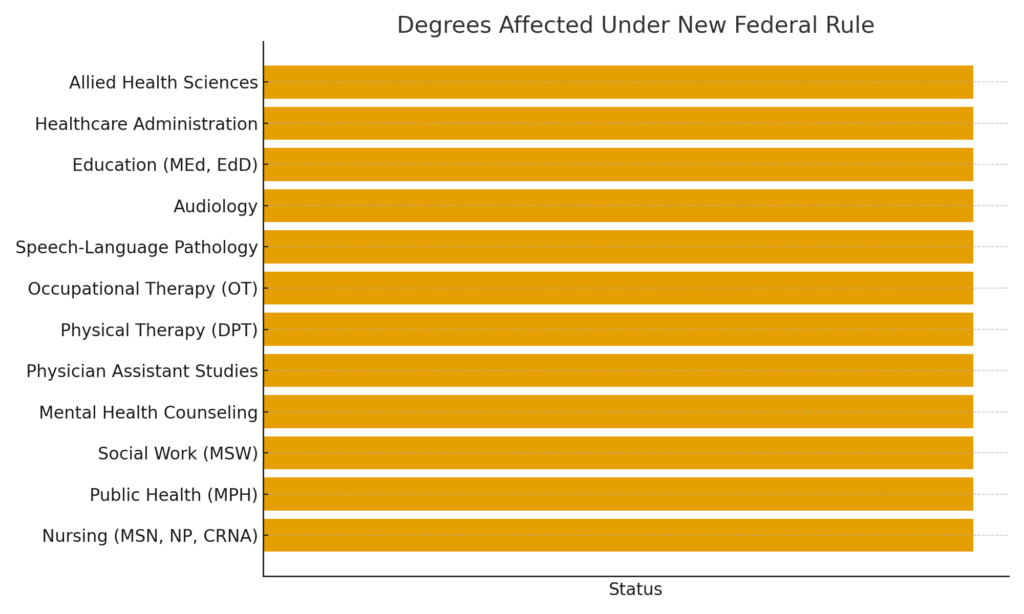
The United States Department of Education has introduced a new regulatory standard that dramatically narrows which fields qualify as professional degrees. For decades, students pursuing careers in nursing, public health, social work, mental-health counseling, education, therapy and other essential fields understood that their graduate programs were considered professional training. Under the new definition, many of these programs will no longer qualify.
This change matters because the federal government has created two separate borrowing tracks for advanced students. Graduate students get a lifetime borrowing limit of one hundred thousand dollars, while professional students can borrow up to two hundred thousand dollars. The problem is that only a small group of degrees now fall into the “professional” category. Everything else faces the lower cap.
The new definition is strict. To qualify, a degree must require six years of education, licensure, and belong to a narrow list of federally approved fields. Only medicine, dentistry, veterinary medicine, law, pharmacy, optometry, osteopathic medicine, podiatry, chiropractic, and a few theological programs automatically qualify.
Fields left out of the definition include nursing programs, public health degrees, physician assistant studies, social work, physical therapy, education, occupational therapy, mental-health counseling, and other allied-health professions. These are the same professions that keep hospitals functioning, support people in crisis, manage community health, teach America’s children, and provide essential care in every corner of the country. Yet the government has decided these degrees are not “professional” enough to warrant higher borrowing limits.
For students, the consequences are serious. If your degree is not recognized under the new rule, you will be locked into a one hundred-thousand-dollar borrowing cap, regardless of whether your program costs double or triple that amount. After July 1, 2026, the Grad PLUS loan program will no longer be available for new borrowers. This means students in expensive clinical programs will face limited federal aid and may be forced into high-interest private loans just to finish their studies.
Universities will now have to examine each of their programs to determine which ones qualify and how students will be affected. Programs not included under the new definition risk enrollment declines, financial strain, and higher dropout rates. Meanwhile, entire sectors like nursing and mental-health care already struggle with staffing shortages, and this change may push fewer people to pursue those careers.
The timing could not be worse. The United States is facing a national shortage of nurses, therapists, educators and public-health professionals. Access to these fields should be getting easier, not harder. Yet, in typical American fashion, the government has decided to raise the cost of entering essential professions while making it easier for people in traditionally elite fields to borrow more.
In the newest episode of “America Is Not a Real Place,” the message is loud and clear. The people who keep society functioning must fight harder, pay more and jump through additional hoops for the privilege of serving the public. At the same time, the degree classifications that determine loan limits are being reshaped without any consideration for real-world job demand, salary expectations or the nation’s needs.
This new policy may seem like a quiet bureaucratic shift, but its real-world consequences will be loud. It threatens the affordability of graduate education, widens inequality, and undercuts the workforce pipeline in some of America’s most critical fields.
